


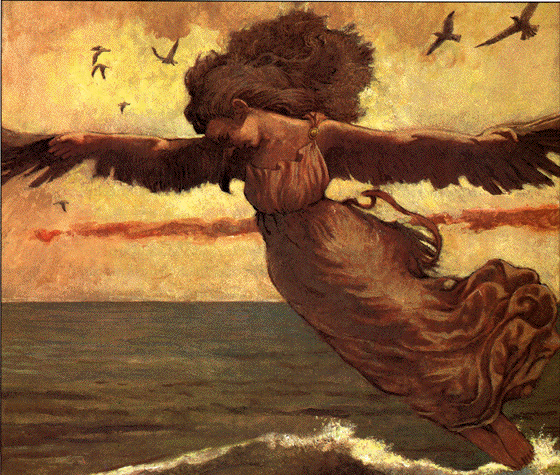
featured composition
upcoming events

5 March 2010
Performances of Power Struggle, Celtic Xylophone & Song to the Moon at Music for All Nat'l Percussion Festival (Indianapolis, IN)

6 March 2010
Guest Soloist/Clinician at Washburn University (Topeka, KS). Performing Gillingham's Concerto No. 2 for Marimba & Wind Ensemble, Mvt. I & Daughtrey's Concerto for Vibraphone & PE, Mvt. I

23 May 2010
Performing Gillingham's Concerto No. 2 with Mt. Lebanon Percussion Ensemble at National Conference on Percussion Pedagogy (University of Oklahoma)

subscribe to my blog

Share your email address:

Delivered by FeedBurner

search site
Saturday
23Jan2010

it was a strange dream: artist & storyteller brian andreas as muse

Strange Dream by Brian Andreas
It was a strange dream, he said,
& I don't remember a thing except
it kept my attention the whole time.

(*Disclaimer: There will be many links in this entry, as I do want to share as much of Brian's related work as possible.)

Sometime during my undergrad (um-teen years ago-ish), I became aware of the works of artist and storyteller Brian Andreas. He creates StoryPeople (http://www.storypeople.com) – sculptures made of found objects, such as wood and wire – covers them with vividly colored paint, and prints short little quirky, poignant & inciteful stories about life, love and the general pursiot of happiness & goodness. These stories are also available as colorful prints, furniture, books, postcards, and wherever else your imagination might take you. Scanning the walls of my home, you might discover five or six of these prints sprinkled about creating an air of whimsy.

When I first started composing during grad school, I was constantly in search of new forms of inspiration. I was about to start writing a duet for alto saxophone and marimba to enter in a composition contest (which I subsequently lost) and decided to turn to a couple of books of Brian's stories. The name of one of these books was "Strange Dreams" which immediately struck me as the perfect title for a collection of these 4 little vignettes for sax & marimba. Then I read the corresponding story to the title (above) and immediately thought it captured how I wanted people to perceive my music. I mean of course I want them to remember it, but capturing their attention so they are living 100% in the moment for at least the duration of the composition.

The stories I chose for each of the four movements were Unheard Music, Ballerina Mom, Mermaid Song, and Pools of Light. I encourage you to follow these links to read each of these stories. The RoseWind Duo (University of South Carolina professors Clifford Leaman, alto saxophone and Scott Herring, marimba) recently released a fantastic recording of the piece on the Equilibrium label and it is available on iTunes.

I have since returned to Brian's stories as the source of inspiration for two more of my compositions. One was a duet for marimba and vibraphone titled Edge of the World, which I gave as a wedding gift to two of my former students and now friends, Michael & Sara Wood. It is based on the story True Things ("They came to sit & dangle their feet off the edge of the world & after awhile they forgot everything but the good & true things they would do someday."). The other is a duet for piano and marimba titled Almost Beyond ("She laid on my chest & her breathing filled me to almost beyond what I could hold.")and commissioned by another husband/wife duo, Una Duo.

Something tells me this will not be the last time I use Brian Andreas and his writings as my muse, so stay tuned. I'm pretty excited about a future collaboration with him, but more on that when it actually comes to fruition. In the meantime, I highly recommend following him on Twitter (@briandandreas). Every time he tweets, another one of his little stories flows right on out of him, usually in the same vain as his StoryPeople, but if you're lucky, occasionally you catch a much edgier Brian Andreas giving him even more depth. I've been fortunate enough to become long-distance friends with him as a result of the mutual admiration of our respective artistic offerings.

Summary of Places to Find Brian:
StoryPeople website: http://www.storypeople.com
Zen Bandit (his personal blog site that hasn't been updated for a while): http://www.zenbandit.com/
Twitter: http://twitter.com/brianandreas

Wednesday
20Jan2010

Enchanted Light (Concerto for Vibraphone, Mvt. II)

After months (well... really a couple of years) bleeding inspiration all over my manuscript paper, the Concerto for Vibraphone and Percussion Ensemble commission is complete! When I finished the first movement, I mentioned some of the inspiration behind the piece, but I'd like to go into a bit more depth here about it.

One of my favorite sources of inspiration for my compositions is poetry – especially that of Pablo Neruda. It's so passionate and filled with vivid imagery that it's just a blast to try and portray his words with music. I knew from the outset that Lisa Rogers (the commissioning party) wanted a 2-movement concerto, so I decided to try and find two poems with opposing themes and stumbled upon Neruda's collection "Ode to Opposites." I chose "Ode to Nighttime" and "Ode to Enchanted Light" which pit night against day.


I. Night's Song

Ode to Nighttime by Pablo Neruda
(I. Night’s Song – “El Canto de la Noche”)

Behind
daylight,
behind every tree and rock,
behind every book,
night,
you rush around working
or you rest,
waiting
for your retracted roots
to grow into foliage or flower.
You thrash around the sky
like
a flag,
you pour yourself into
sierras and seas
and the smallest cavities, too:
the exhausted peasant’s hardened
eyes
and the black coral
of people’s mouths
opened wide in sleep.
You run wild
over the savage flow
of rivers,
you penetrate, night, hidden paths
and love’s deep constellations—
tangle of naked bodies—
and crimes that splatter
the shadows with screams.
All the while trains
stay on schedule, stokers
feed night-black coal to red fire.
The overworked accountant
wanders deep in a forest
of petrified papers,
and bakers knead
mounds of whiteness.
Night also sleeps
like a blind horse.
It’s raining all over the country:
on the huge trees
of my homeland
and on roofs
of corrugated metal
night’s song
is heard.
Rain and darkness are the blade
of a singing sword
while stars, or jasmine petals,
gaze
from blackened heights:
they are signs
that, little by little,
with time’s slow passage,
we will come to understand.

Nighttime,
my nighttime,
night of the whole earth,
you bear something
within you, something round
like a child
about to be born, like a
bursting
seed:
it’s a miracle,
it’s daylight.
Your beauty is all the greater
because you nourish this budding poppy
with the darkness that flows in your veins,
because you work with your eyes closed
so that other eyes may open
and the water may sing,
so that our lives
might be born again.

For the first movement, Night’s Song, I tried to depict this mysterious, starry night that gradually turns dark and rainy. The phrases that really spoke to me and shaped the music were “behind daylight,” “you thrash around the sky,” “you run wild over the savage flow of rivers,” and rain and darkness are the blade of a singing sword while stars, or jasmine petals, gaze from blackened heights.” I love how Neruda describes daylight as being born nighttime, so I decided to make the movements attacca so that the second movement, Enchanted Light, bursts forth out of the first movement.


II. Enchanted Light

Ode to Enchanted Light by Pablo Neruda
(II. Enchanted Light – “La Luz Encantada”)

Under the trees light
has dropped from the top of the sky,
light
like a green
latticework of branches,
shining
on every leaf,
drifting down like clean
white sand.
A cicada sends its sawing song
high into the empty air.
The world is
a glass overflowing
with water.

The second movement is much more sparkly and bright, depicting the “light dropping from the top of the sky.” The “cicada sending its sawing song high into the empty air” even makes an appearance when the ensemble vibraphone player places pennies on the bars and then bows those bars with optional help from a sizzle cymbal. Motives and themes from the first movement return in several spots throughout the second movement helping to unify the work. The soloist gets a workout as well in the tour-de-force second movement, unlike the much more introspective first movement.

The piece will be performed in its entirety at the International Society for Music Education (ISME) Conference in Beijing, China in August 2010 by the Texas Tech University Percussion Ensemble, directed by Allan Shin, with Dr. Lisa Rogers as the vibraphone soloist. I will be using the first movement on a clinic I'll be giving at the Idaho State University Day of Percussion next weekend.

The piano reduction is complete and wind ensemble and full orchestra versions will be completed by this summer.

Friday
08Jan2010

Limerick Daydreams Featured in a Book + a New Recording from Maestro Ray Cramer

While sitting in the audience during a performance of Limerick Daydreams by the UNC-Greensboro Percussion Ensemble, I started to imagine how it might sound to score the piece for wind ensemble. Just a few days later it was all orchestrated and ready for a band to try it out. Dennis Fisher, conductor of the University of North Texas Symphonic Band, agreed to perform the premiere of the new version and had some wonderful tips for me along the way. Since then, the piece has been performed by the UNT Wind Symphony and the Lone Star Wind Orchestra (both under the baton of Eugene Corporon), the NY & NJ All State Bands and the Indiana University Wind Ensemble (all conducted by Ray Cramer) and many other bands around the world.

A little over a year ago, Dennis Fisher told me that "Limerick" would be featured in the 7th Volume of Teaching Music Through Performance in Band. According to the GIA Publications website, "this book includes extensive analyses of a broad range of the best wind band literature being published today. Each Teacher Resource Guide includes a description of the composer, historical perspectives, technical considerations, stylistic considerations, a breakdown of music elements, a form and structure analysis, and more." Dennis did a wonderful job writing the article for the piece.

Unrelated to the book is the new recording I received late in the summer from Maestro Ray Cramer, Conductor Emeritus of the Indiana University Wind Ensemble, of a live performance he had conducted with the Mushashino Academy Wind Symphony in Tokyo, Japan. He tells me that a studio recording is forthcoming, but until then take a listen to this magical performance.


Limerick Daydreams (for wind ensemble)

Musashino Academy Wind Symphony
Maestro Ray Cramer, conductor

Limerick Daydreams is available from C. Alan Publications or any of your favorite music dealers.  :)

Wednesday
06Jan2010

Rusalka's Song to the Moon Redux (thanks to an inspired new recording)

In the summer of 2009, Dr. John Parks, Professor of Percussion at Florida State University, contacted me telling me that the FSU Percussion Ensemble had performed my arrangement of Song to the Moon and that they had added a soprano soloist to the mix and it worked beautifully. He also informed me they would be recording the piece with soprano for their forthcoming CD release and asked if I might add some of the introductory material from the original opera scoring, featuring lush low strings and a brief harp cadenza. The FSU Percussion Ensemble CD, titled Volume One, features Song to the Moon with soprano soloist Marcía Porter in addition to works by David Skidmore, John Cage, Blake Tyson, Astor Piazzolla, and more.

Check out the rough cut of FSU's new recording of Song to the Moon:

Song to the Moon
Florida State University Percussion Ensemble
Dr. John Parks, director | Marcía Porter, soprano

Then, be on the lookout for the official release of the CD. I've heard 3 more tracks and the ensemble sounds really fantastic with an assortment of music from some fresh new voices on the scene.

Now for some of the technical information accompanying the new edition that was just released today by C. Alan Publications:

Program Notes

Song to the Moon is an aria from Antonín Dvorák’s opera “Rusalka,” which combines elements from three fairy tales, Hans Christian Anderson's Little Mermaid, Friedrich de la Motte Fouque's Undine, and Gerhart Hautpmann's The Sunken Bell. At this moment in the opera, the good-natured old Spirit of the Lake, Jezibab, is enjoying the singing of the Wood Nymphs, when his daughter, Rusalka, approaches him sadly. She tells him that she has fallen in love with a handsome young prince and wishes to become human in order to know the bliss of union with him. Deeply saddened, the Spirit of the Lake consents to her request, and leaves. All alone, Rusalka sings this beautiful aria, confiding in the moon the secrets of her longing.

Silver moon upon the deep dark sky,
Through the vast night pierce your rays.
This sleeping world you wander by,
Smiling on men's homes and ways.
Oh moon ere past you glide, tell me,
Tell me, oh where does my loved one bide?
Oh moon ere past you glide, tell me
Tell me, oh where does my loved one bide?
Tell him, oh tell him, my silver moon,
Mine are the arms that shall hold him,
That between waking and sleeping he may
Think of the love that enfolds him,
May between waking and sleeping
Think of the love that enfolds him.
Light his path far away, light his path,
Tell him, oh tell him who does for him stay!
Human soul, should it dream of me,
Let my memory wakened be.
Moon, moon, oh do not wane, do not wane,
Moon, oh moon, do not wane....

Notes About the New 2nd Edition

  • Return to the original key of G-flat major. Because I had not originally intended for the arrangement to be performed with soprano, I put the piece in G major, transforming it from 6 flats to 1 sharp. By putting it in its original key, there is now the possibility of adding a soprano soloist with this aria in her repertoire.
  • A new 27-bar introduction sets up the aria beautifully.
  • A modified softer ending to better match the original aria.
  • Phrase markings have been added to every part to clarify melodic intentions.
  • Rolls markings in the marimba parts have been clarified throughout.
Wednesday
23Dec2009

Remembrance Revisited: Variations on Peace

Nearly one year ago, I took on an overly ambitious 365 project as a way of honoring the memory of my mother, Mary-Jo Daughtrey, who passed away on January 1, 2008. I took one of her favorite songs from church, "Let There Be Peace On Earth," and attempted to write a new variation on the theme every day throughout the year 2009. The project, or rather I, fizzled after 73 variations, but I was left with several little pieces of music that I'm quite proud of. I went through all of the proper channels to get permission for such an undertaking, which meant paying the copyright owners a licensing fee to arrange the song and host the recordings on my website. Unfortunately, they will be charging me a prohibitive amount every year I keep the variations on my website, so all will be removed come January 1st.

So... I'd like to share 12 of my favorite variations here, then you can choose whether you want to visit the other 61. All recordings were electronically generated from the Finale notation program using sounds from Virtual Drumline 2.5 and Garritan Personal Orchestra with the exception of two of the variations for which I recorded my own voice or otherwise. Please be patient, as some of these sound files take a little while to load.

Let There Be Peace on Earth
by Sy Miller and Jill Jackson
Copyright © 1955, Renewed 1983, by Jan-Lee Music (ASCAP)
This arrangement Copyright © 2009, by Jan-Lee Music (ASCAP)
International Copyright Secured. All Rights Reserved. Reprinted by Permission.

Let there be peace on earth
And let it begin with me;
Let there be peace on earth,
The peace that was meant to be.


Theme


Variation 2 (Dorian Reflection)


Variation 4 (Marimba/Vibraphone/Rainstick)


Variation 27 (echoes of Josh Groban – one of my mom's faves)


Variation 29 (Whole Tone)


Variation 31 (Concert Band Fanfare)


Variation 39 (Upbeat Inversion of the Theme)


Variation 41 (Woodwind Quintet)


Variation 44 (Body Percussion & Tuned Water Glasses Played with Pencils)


Variation 47 (Funk)


Variation 56 (Clarinet/Piano Inversion)


Variation 59 (Full Orchestra)


Variation 66 (Marimba/Vibraphone/Bass)

For the rest of the variations, please start with the first 365 entry. For those of you that followed the project starting at the beginning of the year, thank you so much for your encouragement & support and for helping me to honor my mom.

Happy Holidays & a Wonderful New Year!